East Bay Leadership Council · Health Task Force · October 22, 2026
Paying for Health Care in Contra Costa
What Measure X (2020) and Measure B (2026) tell us about the next funding measure
Shane Reisman · theregional.io
Shane Reisman
Founder, theregional.io · Lafayette
Political data analyst for California candidates, labor and ballot campaigns. Before founding the practice: data strategy at Slalom, Booz Allen Hamilton and IBM, plus congressional affairs and campaign work.
Lafayette Parks, Trails and Recreation Commissioner; creator of the Lafayette-Moraga History Trail; 2024 candidate for the East Bay Regional Park District board.
This analysis compares the results of Measure X (November 2020) and Measure B (June 2026), using the most recent voter data from this morning.

2
Same kind of tax, 15 points apart
58.4%
Voters said yes once
Measure X, November 2020
43.1%
Then support fell everywhere
Measure B, June 2026
1 : 2
Turnout versus persuasion
Best turnout scenario: +0.9 pt. versus Persuading 2 voters in 100: +2 pts. B lost by 13.7.
Sources: Contra Costa County Elections, Statements of Vote (Nov 2020, June 2026); VoterForce precinct analysis
3
Measure X and Measure B, side by side
| Measure X · Nov 2020 | Measure B · June 2026 | |
|---|---|---|
| Rate and length | ½ cent for 20 years (through 2041) | ⅝ cent for 5 years |
| Revenue | About $120M a year | About $150M a year (projected) |
| Vote needed | General tax, 50% + 1 | General tax, 50% + 1 |
| Positioning | Keep the regional hospital open; fund health centers and emergency response | Backfill federal Medi-Cal cuts; up to 93,000 residents could lose coverage |
| Turnout | 83.5% (presidential general) | 44.6% (primary) |
| Result | 58.4% Yes · passed | 43.1% Yes · failed |
COVID in November 2020: before vaccines (first doses Dec 14) and a year before Omicron. Contra Costa was in the state’s orange tier on Election Day, with the winter surge and purple tier two weeks later. Most public schools had been in distance learning since March. Every voter was mailed a ballot, as in June 2026.
Sources: Contra Costa County Elections, Statements of Vote (Nov 2020, June 2026); Richmondside; CalMatters
4
Support fell in every city
Lafayette
Orinda
Walnut Creek
El Cerrito
Danville
Richmond
Concord
Martinez
San Ramon
Hercules
Antioch
Pittsburg
San Pablo
Brentwood
Pinole
Oakley
30%
50% (majority)
70%
−7.5
−7.9
−10.4
−11.4
−12.8
−12.9
−13.9
−15.7
−16.8
−18.1
−18.3
−18.6
−19.2
−20.2
−20.5
−22.0
● Measure X, 2020
● Measure B, 2026
Everywhere kept about ¾ of its Yes vote.
Cities that started highest fell the most points.
● Measure X 2020 Yes ● Measure B 2026 Yes. Scale shows Yes share; numbers at right are the change in points. Precincts grouped by city code. Source: CCC Statements of Vote.
5
Where need is high, Yes votes were high
↑ More Yes on B
More need →
High need, high Yes: Richmond, Pittsburg, Concord · 22% of voters
Low need, high Yes: Lamorinda · 5% of voters
High need, low Yes: Oakley, Brentwood · 2.5% of voters
Precincts in thirds by share below 200% of poverty (ACS 2019–23) and by Measure B Yes (June 2026). Outlined = rural or unmatched. % = share of registered voters.
6
Support climbs with need, on both measures
67.0
55.5
62.2
48.5
58.5
43.8
54.9
40.9
50.0
36.0
Highest need
25–62% poor
17–25%
12–17%
8–12%
Lowest need
2–8% poor
Need and support move together, on both measures.
Even as B lost, the highest-need fifth of precincts still voted 55.5% Yes.
The coalition’s base is the people the safety net serves.
■ Measure X 2020 Yes % ■ Measure B 2026 Yes %. Precincts in fifths by share of residents below 200% of poverty (ACS 2019–23). 469 precincts with 200+ votes.
7
What Measure B’s opponents argued
Cost of living
Half of Californians name it the top issue. Gas prices spiked during the campaign, and opponents called the tax regressive.
“Why now?”
Collection would start in October 2026, before the federal cuts land in January 2027. Opponents said to wait until 2028 and use reserves.
“Where is the money going?”
Opponents pointed to Measure X’s ~$120M a year and county salaries and benefits up 47% since 2020: a spending problem, not a revenue problem.
Not locked to health care
As a general tax, the money went to the general fund. A judge also ordered the ballot description rewritten after opponents called it biased.
Sources: CalMatters, “California voters split on county sales taxes for health” (June 2026), citing PPIC and the Contra Costa Taxpayers Association; Richmondside, “Measure B explained” (May 6, 2026)
8
It wasn’t the low-turnout primary
13.7 pts
How far B fell short: 43.1% Yes against 56.9% No.
+0.04
What B would have gained if the June electorate had looked like a presidential-year one.
+0.9
What B would have gained if every pro-B precinct had turned out like the anti-B precincts.
Persuasion over turnout. The best turnout scenario adds under a point, against a 13.7-point loss. The gap was about minds, not turnout.
Source: VoterForce precinct analysis of the June 2026 Statement of Vote (656 precincts)
9
Other counties’ health taxes passed
Passed
Santa Clara · Measure A
57%
November 2025. About $337M a year toward the county health system shortfall.
Passed
Los Angeles · Measure ER
50.6%
June 2026. Half cent for five years, about $1B a year. Passed by about 25,000 votes.
About $10M campaign, led by community health clinics, with about $4M from labor.
Failed
Contra Costa · Measure B
43.1%
June 2026. Same ballot, same federal-cuts pitch as LA, and it lost by almost 14 points.
The case for health funding can win. Contra Costa voters needed a better answer to “where is the money going?”
Sources: CalMatters; LAist; LA County Registrar certified results (June 26, 2026); CCC Statement of Vote
10
The path forward
The next measure will be won in 2027.
theregional.io · 11
The model: a standing health coalition
A trusted convener, an organization such as the Contra Costa Regional Health Foundation, sets everything up before there is a measure to campaign for.
Everyone at one table
Hospitals, clinics, county health, labor, business, advocacy groups and foundations, as partners and as funders
Shared goals
What the money buys, how it is tracked, and a long-term strategy everyone signs
Community meetings
Every region, starting in high-need communities where support runs highest
Business support early
Bring employers and chambers in at the start, not as late endorsers
Steady communication
Plain reporting on what Measure X has delivered, year-round
Start now
Build the community for a March or November 2028 measure
12
Funding options on the table
| Option | Vote needed | Strength | Watch out for |
|---|---|---|---|
| County general sales tax (Board places it) | 50% + 1 | Proven: Measure X passed this way | Money isn’t locked to health, and opponents use that |
| Sales tax dedicated to health (Board places it) | Two-thirds | Legally dedicated to health | Two-thirds is a very high bar |
| Citizen-initiative dedicated tax (sales or parcel) | 50% + 1 today; two-thirds if Prop 43 passes Nov 3 | Dedicated and majority vote | Signature drive; this route lives or dies on Prop 43 |
| Re-prioritize Measure X | No vote | ~$120M a year already flowing | Takes money from other X programs |
| Parcel tax | Two-thirds | Less regressive than a sales tax | High bar, and pushback from homeowners |
Vote thresholds are general guidance under Prop 13/218 and recent appellate rulings, not legal advice.
13
Nov 3: a live test of Contra Costa’s mood
Our forecast, on the record
49%
Projected Yes in Contra Costa on the regional transit sales tax (range 47–51%): a coin flip. The model is trained on Measure B’s precinct results.
197 precincts, about 42% of expected ballots, sit in the 45–57.5% persuadable band. They decide it.
| County | Projected Yes |
|---|---|
| San Francisco | 64.5% |
| Alameda | 58.5% |
| San Mateo | 50.8% |
| Contra Costa | 49.3% |
| Santa Clara | 48.9% |
| Region | 54% |
Check us on November 4. If the model holds, it is ready to map the next health measure precinct by precinct.
Model: Measure B ~ Props 5, 4, 36 (R² 0.93, ±3.1 pts), scaled to 54% regional poll (EMC, July 2026)
14
Early returns: the same communities lag
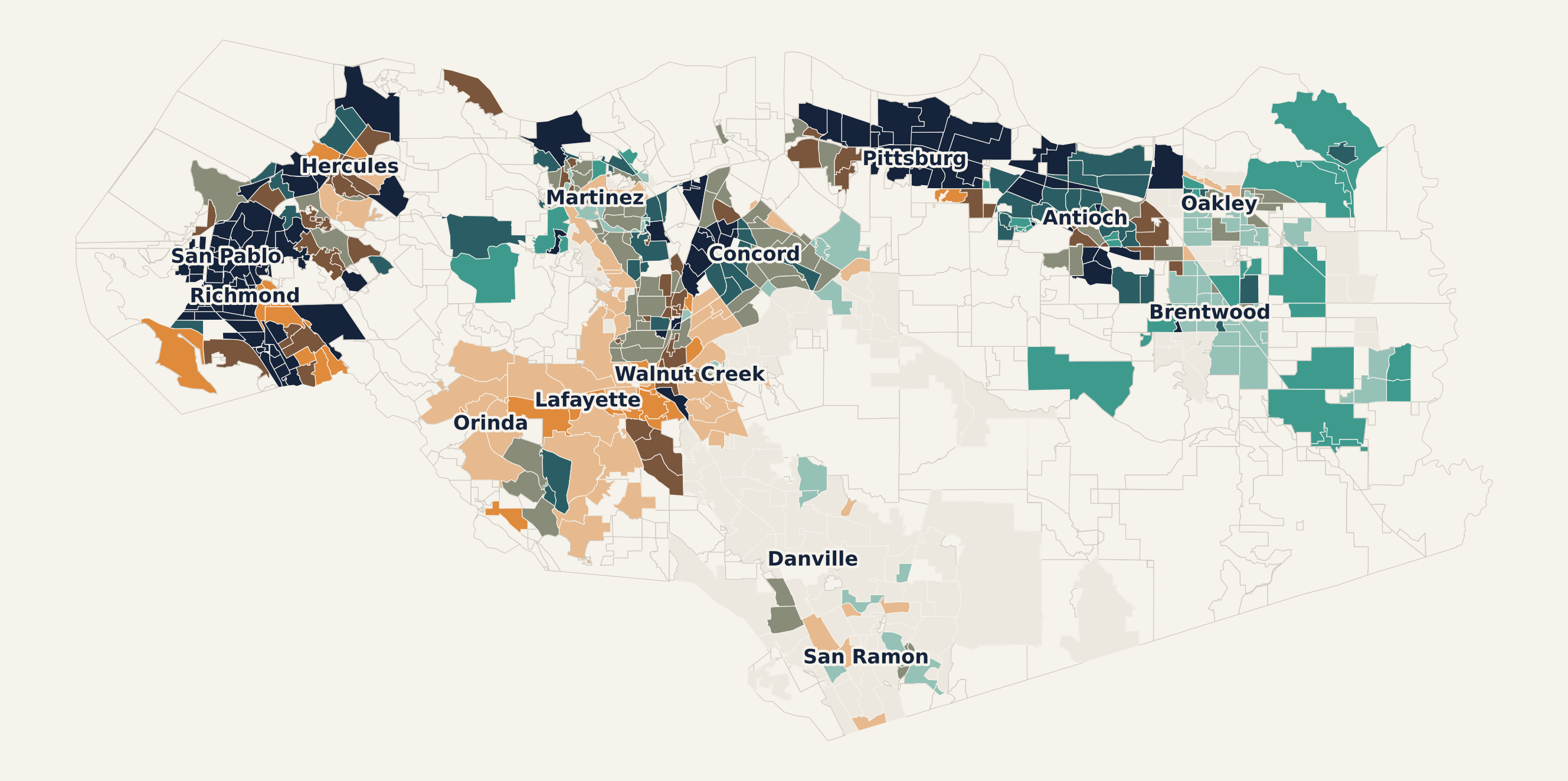
Countywide, 11.8% are back. High-need communities (orange) are returning ballots at about half the pace of the hills.
Mail ballots returned, as of Oct 21
X → B, Yes
Bay Point
6.9%
−17.2
San Pablo
7.6%
−19.2
Pittsburg
7.9%
−18.6
Oakley
8.2%
−22.0
Antioch
8.9%
−18.3
Richmond
9.5%
−12.9
Concord
11.4%
−13.9
Lafayette
15.9%
−7.5
Alamo
16.4%
−12.4
Walnut Creek
17.7%
−10.4
By age: 20.9% of voters 65+ have returned ballots, vs 3.1% of 18–34s.
Source: Contra Costa Elections daily vote-by-mail file, Oct 21, 2026; precincts grouped by city code; X → B = change in Yes share in points, 2020 to 2026 (as on slide 5); age split from PDI Ballot Tracker, Oct 21. Aggregate counts only.
15
Where the data can point the coalition
60%
Moderate, lower-income precincts with high Medi-Cal and SNAP enrollment voted 60% for Measure X, more than affluent deep-blue precincts (55%).
69→51%
The strongest precincts on X slid to barely half on B, so even the base has to be won back.
656
Precincts with results on both measures, so the coalition can pick where to hold community meetings first and track whether support moves through 2027.
People who use public health services cross party lines to support funding them. Partisan targeting alone misses them.
Source: VoterForce precinct analysis; CCC Statements of Vote; DHCS Medi-Cal (Dec 2024); ACS 2019–2023
16
A timeline that starts now
Nov 3, 2026
Watch the transit vote
The regional transit sales tax is the next read on Contra Costa’s appetite.
Now to early 2027
Form the coalition
A convener brings partners together, takes a baseline poll, and shares what Measure X has delivered.
2027
Build support
Community meetings, business sign-on, and agreement on what the money buys.
Mid-Dec 2027
March 2028 decision
Approximate deadline to place a measure on the March 7 primary.
Nov 7, 2028
Presidential general
The kind of election Measure X won. Placement due around mid-August.
Lean toward November 2028. It gives the coalition the most time to persuade, and March only makes sense if the coalition is ready early.
Placement deadlines are about 88 days before an election; confirm exact dates with the Elections Division.
17
Discussion
Questions
Who should be at the coalition table, and which funding option should we test first?
Shane Reisman · shane@theregional.io · theregional.io